November 7, 2025 5 min read

Links: Week of 08 Nov 2025

  1. I'm worried that they put co-pilot in Excel because Excel is the beast that drives our entire economy and do you know who has tamed that beast?

    Brenda.

    Who is Brenda?

    She is a mid-level employee in every finance department, in every business across this stupid nation and the Excel goddess herself descended from the heavens, kissed Brenda on her forehead and the sweat from Brenda's brow is what allows us to do capitalism. [...]

    She's gonna birth that formula for a financial report and then she's gonna send that financial report to a higher up and he's gonna need to make a change to the report and normally he would have sent it back to Brenda but he's like oh I have AI and AI is probably like smarter than Brenda and then the AI is gonna fuck it up real bad and he won't be able to recognize it because he doesn't understand Excel because AI hallucinates.

    You know who's not hallucinating?

    Brenda.

  2. Jasmine Mitchell, the winner of the 16th season of “The Great British Baking Show,” stood out in the competition mainly for her creations — including a cake that was nearly four feet long — but also for her statement earrings, brightly colored outfits and her shiny, hairless head.

  3. Optimism is a psychological attribute characterized as the general expectation that good things will happen, or the belief that the future will be favorable because one can control important outcomes. Previous studies reported that more optimistic individuals are less likely to suffer from chronic diseases and die prematurely. Our results further suggest that optimism is specifically related to 11 to 15% longer life span, on average, and to greater odds of achieving “exceptional longevity,” that is, living to the age of 85 or beyond. These relations were independent of socioeconomic status, health conditions, depression, social integration, and health behaviors (e.g., smoking, diet, and alcohol use). Overall, findings suggest optimism may be an important psychosocial resource for extending life span in older adults.

  4. Depending on how much weight one gives to individual studies and models, versus broader literature reviews and scientific assessments, you can find some evidence for some intensification of some features of tropical cyclone behavior and frequency in some places. But what you won’t find, Norris’ reference to a single unpublished and unpeer-reviewed study notwithstanding, is good evidence that climate change has affected those things very much.

  5. Investigators confirmed that the caller was actually Carl Avinger and that the defendant was not. Nor was he Carl E. Avinger, John Stamp, Bobby Jackson, Craig Taylor, Graig T aylor, Anthony S. Williams, Kevin C. Windley, Kevin Windleg, Corey Blake Duncan, Marco Ferrari, Marco Ferrare, Elvis Taylor or Elvis Teller — names he had used to commit dozens of crimes across the city, on Long Island and as far away as Oklahoma over the last three decades, according to court, jail and prison records, and internal Police Department documents obtained by The New York Times.


    In the months that followed, Melinda Katz, the Queens district attorney, and her prosecutors from the housing bureau unearthed more information about the man whose roughly half-century life had been defined by deceit. But there was one fact they had yet to discover: his name.

  6. UATX will never charge tuition. And we will never take government money.

  7. TL;DR: AI now solves university assignments perfectly in minutes. Students often use LLMs as a crutch rather than as a tutor, getting answers without understanding. To address these problems, I propose a barbell strategy: pure fundamentals (no AI) on one end, full-on AI projects on the other, with no mushy middle. Universities should focus on fundamentals.

  8. Some concepts are easy to grasp in the abstract. Boiling water: apply heat and wait. Others you really need to try. You only think you understand how a bicycle works, until you learn to ride one.

    There are big ideas in computing that are easy to get your head around. The AWS S3 API. It’s the most important storage technology of the last 20 years, and it’s like boiling water. Other technologies, you need to get your feet on the pedals first.

    LLM agents are like that.

    People have wildly varying opinions about LLMs and agents. But whether or not they’re snake oil, they’re a big idea. You don’t have to like them, but you should want to be right about them. To be the best hater (or stan) you can be.

    So that’s one reason you should write an agent. But there’s another reason that’s even more persuasive, and that’s

    It’s Incredibly Easy

  9. So, let’s just walk through the whole thing, end to end. Here’s a twelve-step program for understanding game design.

    One thing I have noticing recently is that there are a ton of interesting blogs out there. Of course, there is substack, but there is a lot more and of extremely high quality except that my discovery model has broken down. Twitter / Google are no longer the best discovery option. I would like a better solution to this problem.

October 31, 2025 5 min read

Links: Week of 01 Nov 2025

  1. H
    Hunter📈🌈📊@StatisticUrban · Oct 27

    Objectively one of the funnier graphs out there. Measured vs. reported male height.

  2. Her most popular package today is her smallest, which costs $325, comes with about 20 pumpkins and takes her six minutes to assemble into a display. The second-most popular is the biggest, at $1,350; that one takes her about 30 minutes. She can do the installations in the dark, wearing a headlamp.

  3. What’s the secret of his health? “To work,” Ono replied to the question by Tokyo Gov. Yuriko Koike, who congratulated him.

    “I can no longer come to the restaurant every day ... but even at 100, I try to work if possible. I believe the best medicine is to work.”

  4. The day Betty Kellenberger hit a patch of freezing rain on Mount Madison, quitting crossed her mind. She was hungry, cold and sore.

    “You’re 80 years old,” she told herself in a pep talk atop a mountain in New Hampshire. “You can do it.”

    A few months later, Kellenberger stood at the Massachusetts-Vermont border, having just finished hiking the entire 2,197-mile Appalachian Trail. She became, without realizing it, the oldest woman ever to do it.

    “We put all kinds of limitations on ourselves,” said Kellenberger, who lives in Carson City, Michigan. “Sometimes the biggest one is we don’t get up and try it.”

  5. The argument from CEO Bernt Børnich is that they’re using the videos from the current state of Neo, where its actions are entirely remote-controlled by employees of 1X Technologies, to train its autonomy. I call bullshit. This looks to me like nothing but a scam. It’s not autonomous at all, I don’t believe this company is going to achieve any practical degree of autonomy with this product, and even while it’s remote-controlled by human operators, it’s slow and clumsy.

  6. For me, the ability to ask unlimited questions and provide unlimited context was a huge unlock relative to visiting a Physio. Also the time saved going to and from the clinic meant I could be much more regular.

    I fully agree that sharing detailed context and inviting clarifying questions are very important.

    In general, A.I. chatbots are far better at offering answers than asking questions, so they tend to skip the important follow-ups a physician would ask, Dr. Turken said — like whether you have any underlying conditions or are taking any medications. This is especially problematic when you’re asking about potential diagnoses or medical advice.

    To compensate, Dr. Turken recommended prompting the chatbot with a line like: “Ask me any additional questions you need to reason safely.”

  7. Huge investments are flowing into QC companies today. IonQ has a $19B market cap, Rigetti has a $10B cap, and PsiQuantum recently raised $1B.3D-Wave is not relevant, despite high qubit counts. Their machines are annealers, rather than gate based, and have less computational power than the QCs that IonQ, Rigetti, PsiQuantum, etc. are working on. This is a lot of money for an industry generating no real revenue, and without an apparent path to revenue over the next 5 years. Qubit counts have not been doubling each year, but even if they did, we'd have 32 kq machines in 2030.4If qubits double each year, 1,000 qubits today grows to 32 kq in 5 years' time. There are few - if any - commercial applications for machines of that size. Will these companies keep raising larger rounds until they achieve 100 kq? Or have they got some secret sauce we don't know about that investors are betting on?

  8. He assumes that the ASICs are obsolete when they can no longer keep up with the hash rate so are no longer mining any Bitcoin. That is wrong. ASICs are obsolete when the Bitcoin they mine no longer pay for the electricity they use. The newer ASICs aren't just faster, they also use much less energy per hash. Look again at the depreciation graph, which suggests current ASICs go obsolete after 16 quarters. But Alex de Vries and Christian Stoll's estimate of 5 quarters to obsolescence is based on comparing the ASIC's production with the cost of their power consumption, which is the correct approach. The curves in the graph are correct out to the 40% line, but then should drop to zero.

  9. Douthat: So we’re going to talk about a lot of things. We’re going to talk about your biography and background, how you came to be an officer in the U.S. military, the future of technology and warfare. But we have to start with a very, very simple question: What is it that Palantir does?

    Sankar: Great question.

    Douthat: Thank you.

    Sankar: Obviously the most important question, yeah.

    Douthat: I spent a long time crafting it, I have to say.

October 24, 2025 2 min read

The Remains of the Day

The Remains of the Day by Kazuo Ishiguro, and the Oscar-nominated film.

I recently read The Remains of the Day by Kazuo Ishiguro, after coming across a positive review and remembering that there was an Oscar nominated movie based on the book in the '90s, when watching the Oscars used to be in thing in India.

After the first couple of chapters, thinking that this was perhaps an artsy book, I also opened up a chat with ChatGPT to improve my understanding of the book.

This was useful but note to self: in future explicitly tell ChatGPT to avoid spoilers or otherwise reveal information or conclusions from the later chapters. To be fair, I did ask for themes to notice in rest of the book so its mostly on me.

This isn't a thriller so in one sense the damage was limited. It is, however, a very subtle book that gradually unveils its layers and getting a bunch of bullet points upfront, spelling out every complexity and nuance wasn't ideal.

The book is a masterpiece. Very few books have ever had this effect on me where, for days afterwards, I suddenly get a flash of feeling, a pang that forces me to stop for a breath.

The closest analogy that came spontaneously to my mind was of eating great Japanese food (yes, even as a vegetarian) - the flavours are extremely subdued - very much the opposite of, say, Indian food. But they are unmistakable, sharp even, if you stop and notice, and you know it took a lot of effort and craftsmanship to pull it off just right.

When reading fiction, I have a tendency to really flip pages towards the end, a tendency developed from years of reading mostly thriller novels. Because of this I found the book depressing, having barely spent any thought on the final pages. It is only while writing this post that I revisited the ending (and the title) and had to reconsider my understanding.

I had identified so deeply with the sense of loss in the middle of the book that I completely missed the gentle ray of hope that Ishiguro leaves us with at the end: as humans, on any given day and at any given time, all we can do is to make the best of whatever remains of the day.

Highly recommended.

October 24, 2025 4 min read

Links: Week of 25 Oct 2025

  1. Donovan’s journey to a hair system started two decades ago when, as a 20-year-old, he noticed his hair was receding. He remembers one moment when he was warming up for a game against FC Dallas in Frisco and fans started chanting at him: “Rogaine! Rogaine!”

  2. Working through the consequences of this, it is not difficult to see why the left has been unable to get much traction out of these changes, especially in developed countries. People are not rebelling against economic elites, but rather against cognitive elites. Narrowly construed, it is a rebellion against executive function. More generally, it is a rebellion against modern society, which requires the ceaseless exercise of cognitive inhibition and control, in order to evade exploitation, marginalization, addiction, and stigma. Elites have basically rigged all of society so that, increasingly, one must deploy the cognitive skills possessed by elites to successfully navigate the social world. (Try opening a bank account, renting an apartment, or obtaining a tax refund, without engaging in analytical processing.) The left, to the extent that it favours progress, is essentially committed to intensifying the features of the modern world that impose the greatest burdens of self-inhibition on individuals.

    Seeing things in this way makes it easier to understand why people get so worked up over seemingly minor issues, like language policing. The problem with demanding political correctness in speech, and punishing or ostracizing those who fail, is that it turns every conversation into a Stroop test, allowing elites the opportunity to exhibit conspicuous self-control. It requires the typical person, while speaking, to actively suppress the familiar word that is primed (e.g. “homeless”), and to substitute through explicit cognition the recently-minted word that is now favoured (e.g. “unhoused”). Elites are not just insensitive, but positively dismissive of the burdens that this imposes on many people. As a result, by performing the cognitive operation with such fluidity, they are not only demonstrating their superiority, they are rubbing other people’s faces in it. (From this perspective, it is not surprising that the demand for “they/them” pronouns upset some people even more, because the introduction of a plural pronoun forces a verb change, which requires an even more demanding cognitive performance.)

  3. Everyone under 30 is prematurely old (worried about savings, career, FIRE).

    Everyone over 50 is desperately young (Burning Man, psychedelics).

    My theory: Information abundance aged the young by showing them all future problems all at once.

    Information abundance also made the old young by showing them all missed experiences all at once.

    So now Gen Z talks like retirement planners and boomers act like teenagers.

    It's so over.

    FN
    Fernando Nikolić 🇦🇷 🟠@basedlayer · Oct 18

    Everyone under 30 is prematurely old (worried about savings, career, FIRE).

    Everyone over 50 is desperately young (Burning Man, psychedelics).

    My theory: Information abundance aged the young by showing them all future problems all at once.

    Information abundance also made the old young by showing them all missed experiences all at once.

    So now Gen Z talks like retirement planners and boomers act like teenagers.

    It's so over.

October 17, 2025 3 min read

Links: Week of 18 Oct 2025

  1. Happy Diwali to those who celebrate! NYT had two glossy stories on just one Diwali Ball in New York organized by Priyanka Chopra's manager. Made me go "Hmmm...". Was this about Diwali, was this about Priyanka Chopra or was this something else?

  2. The pendulum has swung away from wokeness and cancel culture, as it should have. But sometimes it feels like, instead of passing through the center it went straight to the other end.

  3. Title arbitrage is one of the most scalable levers a company can pull to increase the status of certain roles and attract talent. It costs nothing, works at scale, yet has the ability to reshape labor markets. The design space for title arbitrage remains wide open.

  4. There are many ways through which the LLM subscriptions pay for themselves. For me it was physiotherapy. Here it is filing tax returns. I also wish more people would share "how tos" for solving different problems with LLMs. Here's a manual for tax returns. Full disclosure: I haven't tried it yet but the source is credible.

    PM
    Patrick McKenzie@patio11 · Oct 15

    @TheZvi Are you going to write an essay about that second thing or do I have to, because feels extremely obvious that there needs to be a URL “They can now successfully shake money tree for you *additively to what your highly paid advisor will do.*”

  5. "To provide some sense of scale, that means the equivalent of about $1,800 per person in America will be invested this year on AI". That is a bucketload of spending.

  6. China cannot win the decoupling because they face an impossible trilemma: protect the currency, bail out the banks, or maintain social stability. They can pick two at most. More likely, they get one. The math is unforgiving: $5-10 trillion in hidden property losses against $3 trillion in bank equity. That’s not a solvency problem—it’s a physics problem. Meanwhile, they’re bleeding $1.1 trillion annually just to hide the losses, burning their entire defense and R&D budget combined on financial zombies.

  7. Now that wokeness is over, is it ok to link to Louis CK clips again? Can one separate the art from the artist? I don't know but I love this one:

October 10, 2025 3 min read

Links: Week of 11 Oct 2025

  1. JS
    Justin Skycak@justinskycak · Oct 4

    Last year I had a conversation with someone who majored in physics at UChicago. He initially started in math & thought he was prepared having taken AP Calculus BC, but he got smacked in the face by the level of abstraction and proof-writing ability that was assumed.

    He couldn't keep up with his classmates who had already done proofs while taking even MORE advanced courses in high school. So he switched to physics where proofs were less frequent & the playing field felt more level in terms of prior knowledge that classmates had coming in.

    He would have liked to study math if he had more time to catch up, or if he knew earlier how far behind he was – but he did great in his high school math classes & was recognized as one of the "smart kids," so he never suspected he was actually behind the curve.

    Zooming out, this case study is representative of a general phenomenon that can sneak up on you when you’re at, say, the 99th percentile of a skill.

    At first, you’re exceptional enough that you receive praise from virtually everyone, and you may never go head-to-head with someone who can beat you.

    That is, until you join some specialized program where everyone is at the 99.9th percentile – where, suddenly, you’re the worst one there.

    And here’s the real kicker: if it’s a time-sensitive program, you may be so far behind that it’s infeasible to catch up.

    If you knew the caliber of these people earlier, you could have spent time working harder to join their ranks in the 99.9th percentile…

    but that moment has passed, and now the door is closed on this opportunity.

  2. I think people who are facing a sudden reversal can learn from my experience. You can get through it. You have family, you have friends, you have resources that you don’t even know that you have.

  3. NS
    Noah Smith 🐇🇺🇸🇺🇦🇹🇼@Noahpinion · Oct 9

    Is 5'11" (180.3 cm) tall, average, or short?

October 3, 2025 4 min read

Links: Week of 04 Oct 2025

  1. One day as I was being lectured by a female HR representative for leaving my (cloth, non-medical) mask off for too long during lunch, I could barely hear what she was saying. All I could think of were the uncounted men across untold generations who had lived and died as warriors, with all the honor and pain that entailed. I thought of how men in Ukraine right now lived a modern version of that, while I allowed myself to be subject to the feminized safteyist ideology of everyday civilization.

    The spiritual offensiveness of this contrast hit me like a ton of bricks, more vividly than ever. At that moment I silently made my final decision. I wasn’t going to wait around to hear back from the Ukrainian Government. It was time, in the immortal words of an ISIS recruiter on Twitter to “put down the chicken wings n come to jihad, bro”.

    The entire non-book review contest at Astral Codex Ten has been fantastic.

  2. Like most people, I’ve noticed that time seems to speed up as one gets older. I moved to California in 2017, and the past 8 years seemed to pass by very quickly. I feel like time is moving twice as fast as when I was 35. Even as a 16-year old high school student I had already noticed that those “long summer vacations” seemed to pass by at twice the speed as when I was only 8 years old.

    In mathematical terms, subjective time seems roughly proportional to the inverse of one’s age. (At least since age 3 or 4, before that I recall nothing.) At age N, each lived year represents 1/nth of our life. If this is true, then this has some fairly startling implications.

  3. LN
    Leading Nowhere@leading_nowhere · Oct 2

    A life well lived, can anyone ask for more.

  4. NS
    Noah Smith 🐇🇺🇸🇺🇦🇹🇼@Noahpinion · Apr 22

    What's also kind of nuts about this is how spiky China's pyramid is, compared to how smooth India's is.

    Those spikes are the legacy of the Great Leap Forward famine and the One-Child Policy.

  5. Let me repeat that: Parties are a public service, you’re doing people a favor by throwing them. Someone might meet their new best friend or future lover at your gathering. In the short term, lovely people may feel less lonely, and that's thanks to you. In the long term, whole new children may ultimately exist in the world because you bothered to throw a party. Throwing parties is stressful for most people, but a great kindness to the community, so genuinely pat yourself on the back for doing this.

    Not so much facts, as very good opinions, but still.

  6. It has gone largely unnoticed that time spent on social media peaked in 2022 and has since gone into steady decline, according to an analysis of the online habits of 250,000 adults in more than 50 countries carried out for the FT by the digital audience insights company GWI. And this is not just the unwinding of a bump in screen time during pandemic lockdowns — usage has traced a smooth curve up and down over the past decade-plus.

    Societies, generations tend to develop immunity from toxic trends over time.

  7. It has gone largely unnoticed that time spent on social media peaked in 2022 and has since gone into steady decline, according to an analysis of the online habits of 250,000 adults in more than 50 countries carried out for the FT by the digital audience insights company GWI. And this is not just the unwinding of a bump in screen time during pandemic lockdowns — usage has traced a smooth curve up and down over the past decade-plus.

    Is it surprising that a system trained on human output is tribal, favoring in-group over out-group?

  8. Please expect a very high rate of change from us; it reminds me of the early days of ChatGPT. We will make some good decisions and some missteps, but we will take feedback and try to fix the missteps very quickly. We plan to do our iteration on different approaches in Sora, but then apply it consistently across our products.

September 26, 2025 4 min read

Links: Week of 27 Sep 2025

  1. SA
    Sam Altman@sama · Sep 25

    Today we are launching my favorite feature of ChatGPT so far, called Pulse. It is initially available to Pro subscribers.

    Pulse works for you overnight, and keeps thinking about your interests, your connected data, your recent chats, and more. Every morning, you get a custom-generated set of stuff you might be interested in.

    It performs super well if you tell ChatGPT more about what's important to you. In regular chat, you could mention “I’d like to go visit Bora Bora someday” or “My kid is 6 months old and I’m interested in developmental milestones” and in the future you might get useful updates.

    Think of treating ChatGPT like a super-competent personal assistant: sometimes you ask for things you need in the moment, but if you share general preferences, it will do a good job for you proactively.

    This also points to what I believe is the future of ChatGPT: a shift from being all reactive to being significantly proactive, and extremely personalized.

    This is an early look, and right now only available to Pro subscribers. We will work hard to improve the quality over time and to find a way to bring it to Plus subscribers too.

    Huge congrats to @ChristinaHartW, @_samirism, and the team for building this.

  2. Right now, however, Beast Industries is hemorrhaging money. It’s had three years of losses, including more than $110 million in 2024. The viral videos account for all of it, overwhelming the profits from Feastables. Donaldson has been spending between $3 million and $4 million on every video he produces for the main YouTube channel, most of which lose money. In 2023, Beast spent $10 million to $15 million shooting videos it never released to the public because they weren’t up to its standards. He also lost tens of millions of dollars producing Beast Games, a popular show for Amazon Prime Video in which 1,000 people competed for $10 million by, among other things, moving a 10,000-pound boulder.

  3. AP
    Alex Prompter@alex_prompter · Sep 22

    This is going to revolutionize education 📚

    Google just launched "Learn Your Way" that basically takes whatever boring chapter you're supposed to read and rebuilds it around stuff you actually give a damn about.

    Like if you're into basketball and have to learn Newton's laws, suddenly all the examples are about dribbling and shooting. Art kid studying economics? Now it's all gallery auctions and art markets.

    Here's what got me though. They didn't just find-and-replace examples like most "personalized" learning crap does. The AI actually generates different ways to consume the same information:

    - Mind maps if you think visually
    - Audio lessons with these weird simulated teacher conversations
    - Timelines you can click around
    - Quizzes that change based on what you're screwing up

    They tested this on 60 high schoolers. Random assignment, proper study design. Kids using their system absolutely destroyed the regular textbook group on both immediate testing and when they came back three days later.

    Every single one said it made them more confident.

    The part that surprised me? They actually solved the accuracy problem. Most ed-tech either dumbs everything down to nothing or gets basic facts wrong.

    These guys had real pedagogical experts evaluate every piece on like eight different measures.

    Look, textbooks have sucked for centuries not because publishers are idiots, but because making personalized versions was basically impossible at scale. That just changed.

    This isn't some K-12 thing either. Corporate training could work this way. Technical documentation. Professional development.

    Imagine if every boring compliance course used examples from your actual job instead of generic office scenarios.

    We might have just watched the industrial education model crack for the first time. About damn time.

Ignoring the hype up top, Google does seem to be creating some practical tools with LLMs. With base LLMs getting quite good now, I wonder if the next unlock is in creating tools with customized workflows for specific tasks. Wrappers.

  1. Periodic Videos
September 20, 2025 6 min read

Links: Week of 20 Sep 2025

  1. If you’ve got a compliment, just let it out.

    JP
    jay plemons@jayplemons · Sep 7

    The Power of a Compliment

    Scott Adams tells the story of a woman in a public speaking class who transforms from terrified to confident through encouraging words from her peers

    @ScottAdamsSays “If you withhold a compliment that you’re thinking, it’s almost immoral.

    If you’ve got a compliment, just let it out.”

  2. And the amazing thing is that the opposite works too!

    I think I mentioned this before but I was a national speech and debate octafinalist in high school and I was able to parlay that into a job running a debate program at an ambitious charter middle school in college.

    My approach was the exact opposite of this. Like half the kids were TERRIFIED of public speaking and were only doing it because their tiger moms insisted they had to (and the other half LOVED the attention).

    I had a lot of trouble getting the scared kids to open up and one day I asked one of the youngest ones what made her so afraid of speaking in front of the class, especially since they were all her friends.

    And she told me she was afraid she’d say something dumb or make a mistake and everyone would make fun of her. And that they’d laugh and laugh at her if she froze up.

    The next day I asked the class if anyone was scared of being made fun of and all the shy kids raised their hands.

    Now I don’t actually know if this is the same pathology in adults with fear of public speaking but I suspect it’s similar, and now I’ll get to how I addressed it which worked fabulously.

    First I told them that this was a ridiculous fear and that no one would make fun of them. But of course that doesn’t do anything lol. But then I told everyone to rip out 10 pieces of paper from their notebooks and crumple them up.

    And I told them I was going to give a speech. I told them if I said “uhh” or “um” or used any filler words they were to throw a paper ball at me and shout “shame!” 3 times pointing at me.

    And I gave a terrible speech. And they loved it! It was so much fun for them.

    But then! I had the students give speeches with the same rules, starting with the confident ones.

    After the third student the shy ones were volunteering.

    After the lesson I explained to them that we had accomplished 2 things:

    1. We had demonstrated how absurd such a reaction really is, because none of them would have ever reacted in that way if they weren’t specifically asked to, and none of them had any actual malice even when they did shout “shame” at their classmates

    2. Everyone had experienced the comically worst case scenario imaginable of public speaking and survived!

    So they became the rule during EVERY class and I was told by the other teachers that my shy students had started leading presentations and speaking up in class and some of them asked me how I worked with them.

    They were HORRIFIED when I told them lol.

    But it worked!

    This reminds me of Boggarts in the Harry Potter books.

  3. This guy is founding an evangelical church, and I find his ecosystem fascinating. First for its stunning similarities to venture-capital-funded tech start-ups, and then for its simplicity and open-heartedness. None of the dynamics in church planting are unique or even particularly rare, but they are unobfuscated, and that makes church planting the equivalent of a large print book for the social dynamics that favor charismatic narcissists.

  4. Finnish tech firm Bluefors, a maker of ultracold refrigerator systems critical for quantum computing, has purchased tens of thousands of liters of Helium-3 from the moon — spending “above $300 million” — through a commercial space company called Interlune. The agreement, which has not been previously reported, marks the largest purchase of a natural resource from space.

  5. CS
    Chris Said@Chris_Said · Sep 17

    Teen depression has *declined* for the past 4 years, after peaking in 2021.

    People should update on this.

    The most parsimonious explanation is @glukianoff's theory that wokeness encouraged catastrophic thinking, acting as a sort of “reverse CBT”.

  6. We received the problems in the exact same PDF form, and the reasoning system selected which answers to submit with no bespoke test-time harness whatsoever. For 11 of the 12 problems, the system’s first answer was correct. For the hardest problem, it succeeded on the 9th submission. Notably, the best human team achieved 11/12.

    We competed with an ensemble of general-purpose reasoning models; we did not train any model specifically for the ICPC. We had both GPT-5 and an experimental reasoning model generating solutions, and the experimental reasoning model selecting which solutions to submit. GPT-5 answered 11 correctly, and the last (and most difficult problem) was solved by the experimental reasoning model.

    and

    An advanced version of Gemini 2.5 Deep Think competed live in a remote online environment following ICPC rules, under the guidance of the competition organizers. It started 10 minutes after the human contestants and correctly solved 10 out of 12 problems, achieving gold-medal level performance under the same five-hour time constraint. See our solutions here.

September 13, 2025 8 min read

Links: Week of 6 & 14 Sep 2025

  1. The journeyman played for eight N.B.A. teams and won one championship. But he is best known for a brief stretch on the Knicks where he electrified fans and the nation.

    How to feel old #3892: Linsanity for 13 years ago and I remember it like it was yesterday!

  2. The amount of planning and thought that needs to go into the enterprise is surprisingly minimal. Count how many days you’re going for, then bring the same number of shirts as the number of days minus one (unless you have access to laundry, then probably less), 2-4 pairs of pants, a couple nicer dresses if that’s your thing and a change of shoes. Something to sleep in at night and a bathing suit if you’re headed somewhere warm. I always bring an extra pair of underwear and socks because sometimes I like to change throughout the day. Then experiment by trying on a bunch items to ensure everything goes together. Frankly, it’s not that different than figuring out what you’re going to wear on a day-to-day basis, which I trust you do all the time.

    Some thinking about packing, maybe some tools (I like using packing cubes and a travel scale is a must when flying budget) are surprisingly useful but yes, the curve drops sharply.

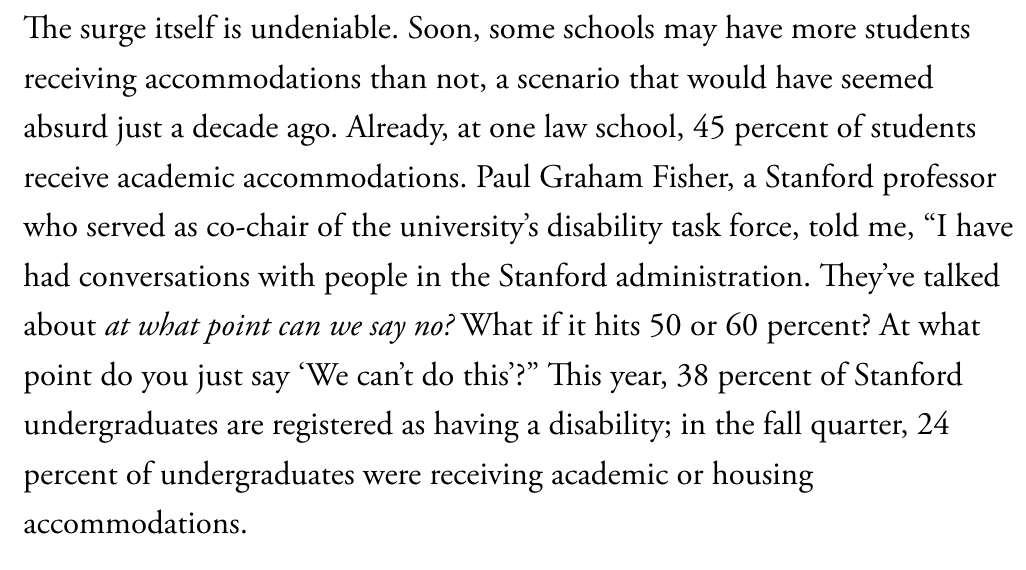
  3. At 22, I thought ADHD was fake. An excuse for underachieving kids to get “accommodations” for procrastinating on their homework. From what vague knowledge I had of stimulants like Adderall, I regarded them with the same scorn as the accommodations.

    Seventeen years later, I credit Adderall with enabling me to build a 10x happier, healthier, more virtuous version of myself (to the chagrin of the countless Twitter trolls decrying my “meth addiction” in reply to this recent viral post). Here is my story.

  4. All this effort — fifty years of non-stop toil — turning a fallow wasteland into fertile earth, and where are all the crops we have to show for it? Where are all the local companies that we can point to and be proud of? Where are our Ericssons and Nokias?

  5. Rob was fantastic but it’s not as though I can just do a TrackMan excursion all the time. Yet I remained curious about why my swing was what it was. I had decent power, but lacked the ability to square the ball up with anything approaching consistency. Was I destined to always have this problem?

    And so I turned to LLMs, feeding the TrackMan stats into GPT. Based on 12 numbers, from one swing, GPT had me clocked. It knew my strengths and weaknesses. It fully understood the specifics of my poor technique. I’m sure Rob could have walked me through as much, but his time is limited. The machine had all the bandwidth in the world to deal with my “over the top” swing, how to fix it, and any other questions I might nag it with.

    A day later, my swing was different and self recorded video sent to Google’s Gemini confirmed the change. Swing errors that were decades in the making were corrected in the span of minutes. I’m not saying that I’ve suddenly made a leap from “Struggles to break 100” to “scratch golfer.” I’m just saying that a process that could have been expensive and arduous was instead efficient and relatively cheap. I apply the LLM’s fix, and it tells me whether I’ve actually applied it. The feedback is instant and objective.

    LLMs will be like Ozempic for a lot more than golf. Ability to ask unlimited questions without feeling embarrased or paying by the hour is a big deal. Imagination is the only thing limiting us.

  6. It’s hard to say exactly why, even with all this progress, current AI models are still so hopeless at dealing with open-ended real-world situations. GPT-5’s inability to recognize that it was incapable of playing Minesweeper may indicate that its reasoning abilities do not generalize well. Its decision to spend 5 solid hours beating its head against the unimportant side goal of sharing a spreadsheet suggests a lack of training on the importance of setting priorities. The repeated factual errors in Gemini 2.5 Pro’s writeup of its merch store experience (click the link and look for “Editor’s Notes”) suggest an inability to keep track of key information over an extended project. Claude losing track of the fact that it is not a person is a reminder that in some ways these models really are just shallow imitations of human behavior (even as they demonstrate deep capability in other areas).

    So many benefits and so many limitations.

  7. Reading a non-fiction book from cover-to-cover is not efficient. I used to say that I read books “from the outside in.” I look at the book flap to find out about the author, who wrote the blurbs, and the subject matter of the book. Then I read the introduction and conclusion in order to get the main ideas. If I have read something by a different author that seems relevant, I look for that author in the index, and I head to those pages.

    and

    Once again, I believe in “Stop, Look, and Listen.” I start by asking the AI to summarize the key themes of the book. For each theme that the AI lists, I stop and try to put it into my own words. I test my understanding by feeding my words into the AI, in order get confirmation that my interpretation is correct. Another way that I ensure understanding is to suggest possible examples or ask the AI to provide examples.

  8. The Zvi has a good survey post on what is going on with the actual evidence. I have a more general point to make, which I am drawing from my background in Austrian capital theory.

    There are easy projects, and there are hard projects. You might also say short-term vs. long-term investments.

    The easier, shorter-term projects get done first. For instance, the best LLMs now have near-perfect answers for a wide range of queries. Those answers will not be getting much better, though they may be integrated into different services in higher productivity ways.

    Those improvements will yield an ongoing stream of benefits, but you will not see much incremental progress in the underlying models themselves. Ten years from now, the word “strawberry” still will have three r’s, and the LLMs still will tell us that. There are other questions, such as “what is the meaning of life?” where the AI answers also will not get much better. I do not mean that statement as AI pessimism, rather the answers can only get so good because the question is not ideally specified in the first place.

    Then there are the very difficult concrete problems, such as in the biosciences or with math olympiad problems, and so on. Progress in these areas seems quite steady and I would call it impressive. But it will take quite a few years before that progress is turned into improvements in daily life. Again, that does not have to be AI pessimism. Just look at how we run our clinical trials, or how long the FDA approval process takes for new drugs, or how many people are reluctant to accept beneficial vaccines. I predict that AI will not speed up those processes nearly as much as it ideally might.

    So the AI world before us is rather rapidly being bifurcated into two sectors:

    a) progress already is extreme, and is hard to improve upon, and

    b) progress is ongoing, but will take a long time to be visible to actual users and consumers

    And so people will complain that AI progress is failing us, but mostly they will be wrong. They will be the victim of cognitive error and biases. The reality is that progress is continuing apace, but it swallows up and renders ordinary some of its more visible successes. What is left behind for future progress can be pretty slow.

    Yet another periodic reminder that MR and The Zvi are both must-read for everyone.

×